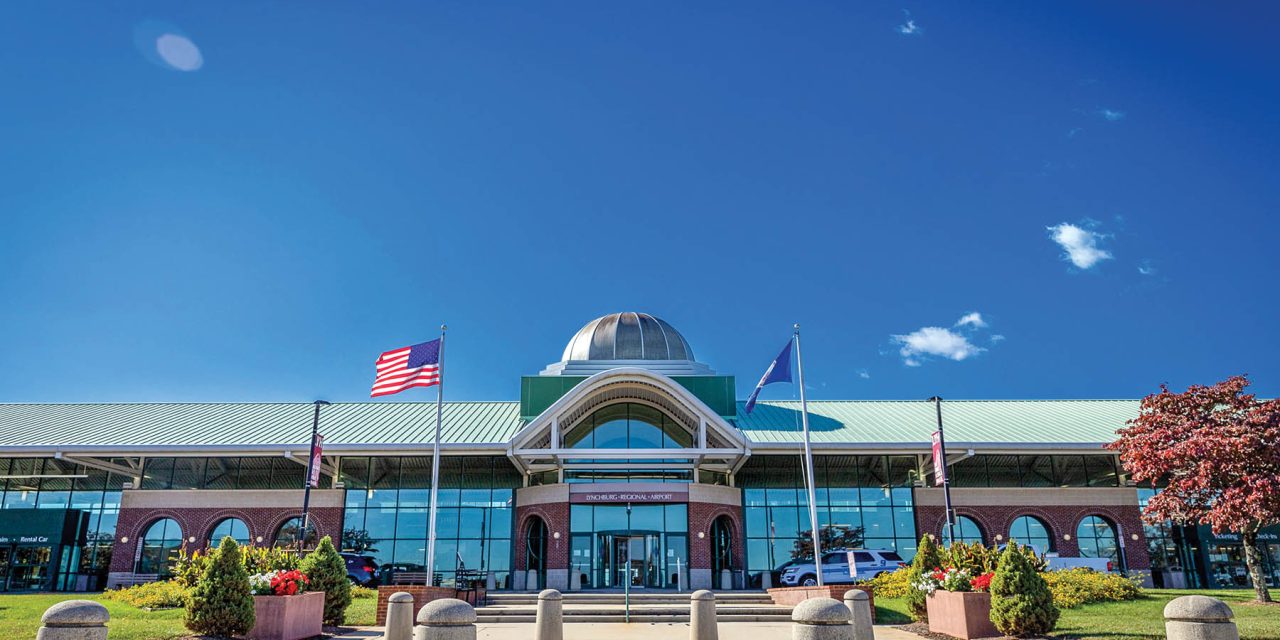
Lynchburg Regional Airport Expansion Poised to Bolster Local Economy
By: Shannon Kelly | Photos Courtesy: Lynchburg Regional Airport
Airports are multifaceted economic drivers: In addition to facilitating and increasing tourism and trade through connectivity, they create jobs and investment opportunities, stimulate local business growth, generate tax revenue, and more. The Lynchburg Regional Airport is no exception.
For years, demand for air travel in a university city where education, industry, business, and tourism converge surpassed the regional airport’s capacity—but that is about to change, thanks to a major milestone.
For the first time in more than a decade, Lynchburg Regional Airport (LYH) will be served by more than one airline, connecting the city with two major hubs and destinations.
When Lynchburg Regional Airport, along with the City of Lynchburg, announced the addition of a new airline carrier and daily runs to Chicago O’Hare International Airport and Dulles International Airport in Washington, D.C. on Oct. 24 last year, the buzz was immediate. The terrorist attacks of Sept. 11, 2001—which changed air travel in the United States forever—in addition to Delta ending its service from Lynchburg to Atlanta in 2011 and the COVID-19 pandemic in 2020, led to major reductions in LYH’s services over the years. The addition of a new daily jet service marks a significant milestone not only for the airport itself and its neighboring markets, but also for the Greater Lynchburg Region’s economy.
United Express—to be operated by SkyWest Airlines—will add daily flights between Lynchburg and O’Hare and between Lynchburg and Dulles, offering flexibility for travelers’ schedules and connections to dozens more domestic and international destinations for leisure or business. These flights are slated to begin service in March 2026.
“It really is a transformational moment for the region—not just [for] the city’s connectivity, [but also] for the employers, for the universities, and [for] a growth trajectory,” said Marjette Upshur, Director of Economic Development for the City of Lynchburg.
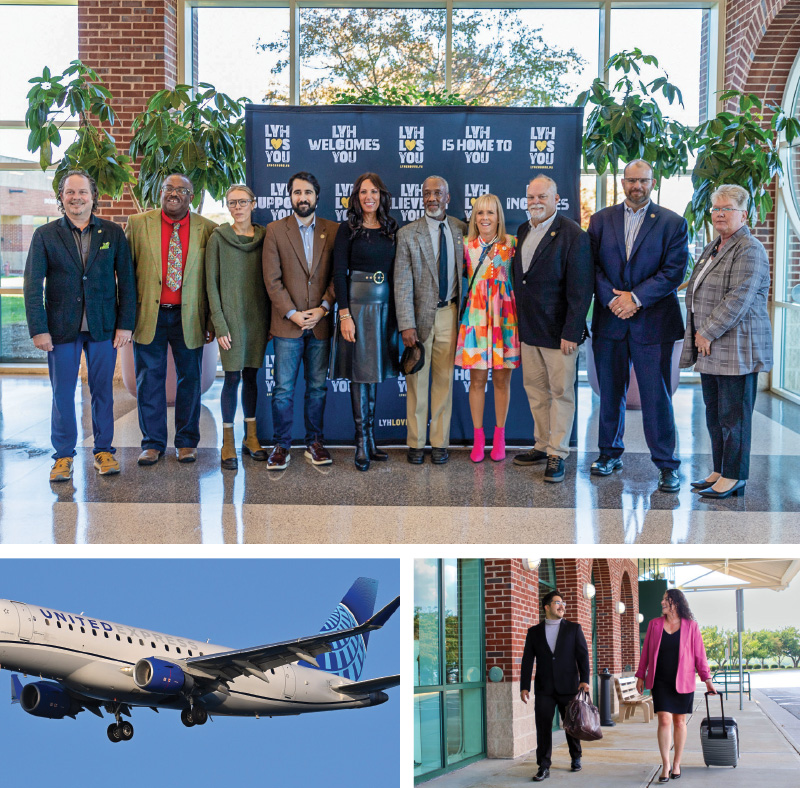
According to Cedric Simon, Director of Lynchburg Regional Airport, Dulles and Chicago services will add approximately 50 new domestic destinations. With 50 seats on each jet, 100 more passengers can be transported out per day, bringing LYH closer to meeting local demand.
Currently, LYH has a demand of about 547 domestic flight passengers per day each way, but only 400 seats are available with the one-airline system.
“If I have 547 passengers a day each way who are flying, and I only have 400 seats, that means there are roughly 150 people every single day who have to look somewhere besides Lynchburg for flights,” Simon noted. “I want to make sure they have the flights here.”
If international passengers are added to those domestic estimates, the daily demand increases to about 612—meaning that an additional 65 seats are needed to fully meet LYH’s demand.
Expanded airline service is projected to boost LYH’s annual passenger capacity from around 80,000 per year closer to pre-pandemic levels of nearly 100,000 passengers flying per year.
“We could theoretically, in maybe 2026 or 2027, hit 100,000 [passengers], which is a personal benchmark for me,” Simon said. “I’d like to hit
that number.”
Prior to the pandemic, LYH averaged about seven flights per day to and from American Airlines’ hub in Charlotte, North Carolina; after the pandemic, only three to five flights have gone through LYH per day. Simon expects this development to get the airport back to pre-pandemic flight numbers.
Airport administrators and city officials hope this development will encourage more travelers to fly from Lynchburg rather than go through Roanoke, Charlottesville, or Raleigh-Durham to reach their connections or destinations.
“Every time somebody flies out of Lynchburg, they’re contributing to the economic development of this city and of this region,” Upshur remarked.
Because Lynchburg boasts major manufacturers that serve national and international audiences and schools like Liberty University, which Upshur said draws an influx of roughly 60,000 people and about $20 million to Lynchburg each year for commencement weekend alone, connecting the city to more of the nation and the world is monumental.
Chicago is Lynchburg’s number six top market, based on Department of Transportation reportable data, Simon said. With the addition of the daily jet service, direct flights will be more efficient and convenient for travelers headed to the Windy City.
Service to Chicago was largely made possible by a Community Air Service Development Program grant through the Department of Transportation, Simon said. The grant was awarded in 2022, and he said it gave the Lynchburg to Chicago service project the “lift below the wings” it needed to get off the ground.
Connection to both O’Hare and Dulles was more than the city hoped for, Upshur noted. Chicago had been the initial focus.
“I mean, we fought, fought, fought, trying to get a northern flight, and obviously, we spent the majority of the time doing that with American [Airlines], because American’s been so good to Lynchburg, a stalwart over all of the years,” she said. “But then, to be able to get … SkyWest United, and then get a Dulles gate, I mean, seven days a week? We come from Dulles to Lynchburg, from Lynchburg to Chicago, from Chicago back to Lynchburg, and then back from Lynchburg to Dulles. I still can’t believe I’m able to even say that.”
The added airline service comes on the tail of other projects happening at LYH.
The Lynchburg Regional Airport recently completed an approximately $15 million rehab project on Runway 422, its commercial runway, largely using funding from the Federal Aviation Administration.
The growth marked by a new airline service and higher passenger counts could potentially open up additional funding sources for the airport, such as competitive grants. In any case, Simon said, more passengers would mean more Passenger Facility Charge (PFC) revenues. Passenger Facility Charges
can be seen on the list of fees associated with ticket costs.
The airline a passenger flies through collects those fees and remits them to the airport of origin, which can then use those funds for various projects such as infrastructure improvements, renovations, and more.
The airport represents a significant component of Lynchburg’s economic vitality.
In 2018, LYH had a roughly $180 million economic impact on the city, according to the Virginia Department of Aviation’s Virginia Airport System Economic Impact Study from that year. An updated study from the same department is due soon. The service expansion at Lynchburg’s airport is projected to have a multi-million dollar economic impact, according to Upshur.
“I would also say that the new service to Dulles and O’Hare provides access to two of the most powerful global airline networks in the world, and that immediately increases our competitiveness in the economic impact that the airport can generate,” Upshur said.
The Lynchburg airport’s growth could have impacts beyond the City of Lynchburg itself, Simon noted. Growth and expanded offerings at a regional airport can help make travel more affordable at neighboring regional airports as well. He views LYH’s relationship with neighboring markets as collaborative, not competitive.
“I don’t think of it like a McDonald’s/Burger King, Pepsi/Coke type of relationship,” he remarked. “I really do think of it like ‘a rising tide lifts all ships,’ so I have a collaborative relationship … with our neighboring commercial service airports. What’s good for one of us is good for all of us.”
Simon credited the development as a major collaborative effort between entities including the airport, the City of Lynchburg, and other economic development partners and stakeholders.
Already, the announcement is attracting more site selectors to choose Lynchburg, Upshur said.
“We hosted six to eight site selectors—these are people who come and scope out sites for businesses that want to have new operations somewhere, or expand into a different market, or want to relocate, or do any of that—and from the stage, they were asked by the audience, ‘What’s the number one thing that we here could do?’” she recalled. “And they go, ‘You just did it by getting an additional air service.'”
Upshur highlighted Lynchburg’s Amtrak service to Washington, D.C. as another “hidden gem” of transportation the area has to offer.
“We just can’t take our foot off the gas ever again … from a transportation perspective,” she said.