Vector Space Celebrates a Decade of Strengthening Local Workforce
By: Emily Mook | Photos by: Ashlee Glen
n the simplest terms, a vector is defined as a quantity that has both magnitude and direction. Concepts such as force and velocity are examples of vectors and can be visually represented by arrows indicating a certain amount of movement oriented in a certain way. These and other movement-focused concepts do not inherently entail intention, but they often do when combined with human agency. When we make decisions and take actions to support those decisions, we set intentional courses—and the degree to which those trajectories reflect our intentions depends on our dedication to staying the course despite any and all obstacles.
One’s career path is undoubtedly one of the most prominent vectors in one’s life, and decisions made in this realm can feel especially daunting and weighty for myriad reasons: an increasingly volatile job market, competition, and imposter syndrome (to name just a few), underscored by a very practical and real need for financial stability. This path to stability—and to the landmarks we seek beyond stability, such as opportunities for growth and self-fulfillment—can evolve from tough to treacherous without the proper skills and support.
Fortunately, local makerspace Vector Space offers both.
Just over a decade ago, Adam and Elise Spontarelli made a collective career decision that would ultimately also help many others find their footing on their career paths, as well as a tight-knit community of like-minded learners and doers: They left their desk jobs—Adam as an engineer for a local engineering firm and Elise as a web designer—behind and established Vector Space in 2015. The two were initially looking for a makerspace to join and participate in with their spare time, but when they realized that Lynchburg didn’t have such a space, the path forward became clear.
“Were there moments of doubt?” Adam said. “There definitely were. But we knew we had marketable skills and good relationships with individuals and companies. When we looked at it from a big-picture perspective, the worst case scenario was wasting some time and money, but doing so for life experience. If that’s all it costs to try to do something that you’re actually passionate about and that could have an important impact on people beyond yourself, we felt like it was worth taking the risk.”
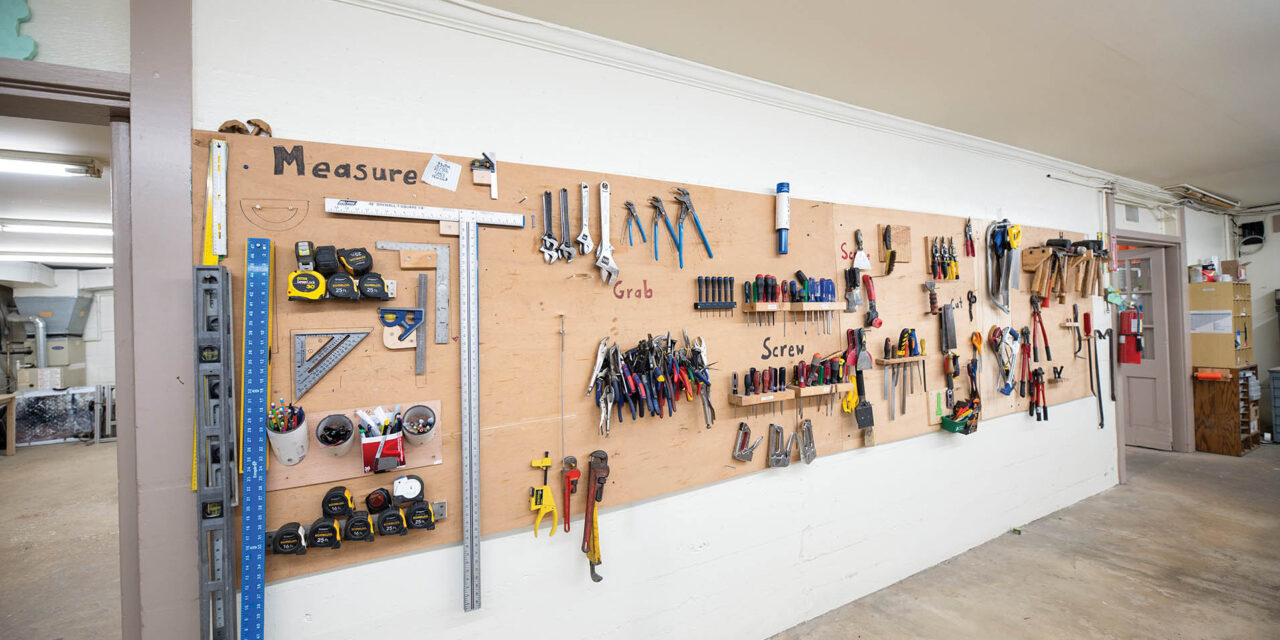
Ten years of operation, two major renovations and expansions in their former space, one relocation to their current 23,000-square-foot facility on Memorial Avenue, one additional staff member (outreach coordinator Mollie Walsh), and hundreds of members and successful programs later, it is abundantly clear that the risk paid off.
In addition to these readily-observable signs of growth, Vector Space has evolved in a way that is less obvious but extremely instrumental when it comes to the makerspace’s prominent role in local workforce enrichment and development.
“A big marker of significant change for the organization is that there was a point at which membership stopped being hard to recruit for, which was great,” Elise noted. “For the first couple of years, we were begging people to join and trying to explain what this was and paint a picture of what it could be. But once people started doing things again after COVID, membership filled and now stays full. We’ve been able to focus our attention on member retention rather than member recruitment, which has been great for the organization. That means that we have been able to invest in the members who are here in a more intentional way and to help them become the best makers they can be and engage in the community.”
To support this shift in focus from recruitment to retention and to ensure that they can offer meaningful onboarding and training opportunities to all members, Vector Space now opens for membership enrollment just three times per year; the next enrollment period begins Sept. 5.
This thoughtful and intentional approach to growth has allowed the Spontarellis to better observe the individual trajectories of Vector Space members and to more fully appreciate the makerspace’s role in shaping their skillsets.
“Sometimes we can look at specific people and remember what they were like when they joined and what their skillsets were,” Elise said. “And now they make beautiful things that people are bidding on for our auction. We can really see the progress in our makers.”
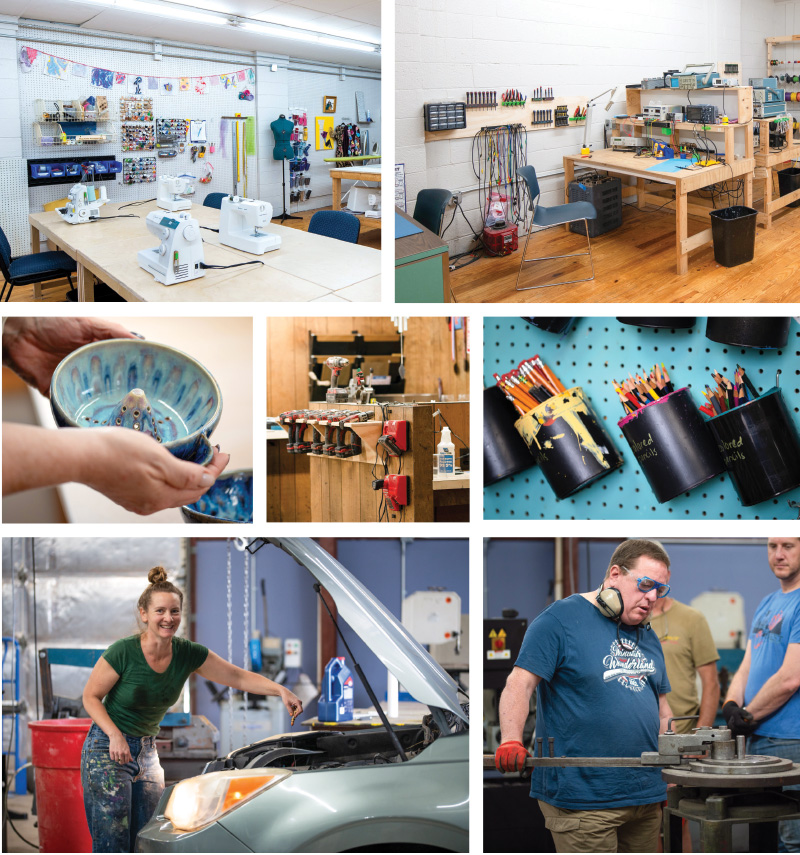
No matter which discipline(s) a member pursues, the skills they learn and the connections they make can and often do directly impact their careers.
For instance, an engineer may decide to build their resume by serving as a mentor for Vector Space’s FIRST Robotics Competition (FRC) team (Team 10257). Or, after building up their skillset by working on toy projects at the makerspace, they may have an opportunity to work on a deployed project that could catapult them to the next level in their career.
“There’s an engineer working on a project here where he’s helping to rebuild one of our tools and change the way it works,” Adam said. “He’s working on the computer system behind the scenes. This tool is a $15,000 tool—you wouldn’t just go buy this tool for your house just so you could develop the software for it. Here is this opportunity for this engineer to work on a real-world problem where we are asking for help, and this project could be deployed for other people and makerspaces to use.”
In addition to these individual opportunities, Vector Space offers “Member Builds” that allow members to both collaborate on shared projects and make connections that could potentially lead to new career opportunities.
“Through that organic peer-working, there are a lot of times where members will meet other people who work at other companies or they’re looking for a job, and this person is hiring, etc.,” said Elise. “That sort of organic job-changing happens here regularly. And sometimes you just work with someone on a project, and you’re like, ‘This is a good person to work with.’ That’s what people, when they’re hiring, are looking for. Who are the people who are good in a pinch, good problem solvers, good communicators—all those sort of soft skills? You can get a feel for that when you’re working here together at the makerspace.”
As Vector Space cultivates a balance between hard and soft skills, it also cultivates a balance between book learning and hands-on learning.
“By high school these days, we usually decide that students are headed in either a trades direction where they’re going to touch things or a book direction where they’re going to think about things,” Elise noted. “But our philosophy with education here is that both of those people need both of those skills. You shouldn’t set out to become a welder if you don’t understand the material properties of what you’re working with and the physics of what’s happening, and you shouldn’t become an engineer without having manipulated things and worked as the person who’s going to do the job that you planned. We offer both the physical and academic aspects of making things here.”
Striving to strike these balances between hard and soft skills and between book learning and hands-on learning is a major undertaking, and the Spontarellis make it their mission to remind all members that it is normal to make mistakes and that learning is a lifelong process.
“Everyone is learning here,” Adam said. “You lose sight of that sometimes because we also have youth programs, and everyone is intuitively used to thinking of youth as being in the learning phase and adults as being past the learning phase. But here, everyone is in the learning phase, all the time.”
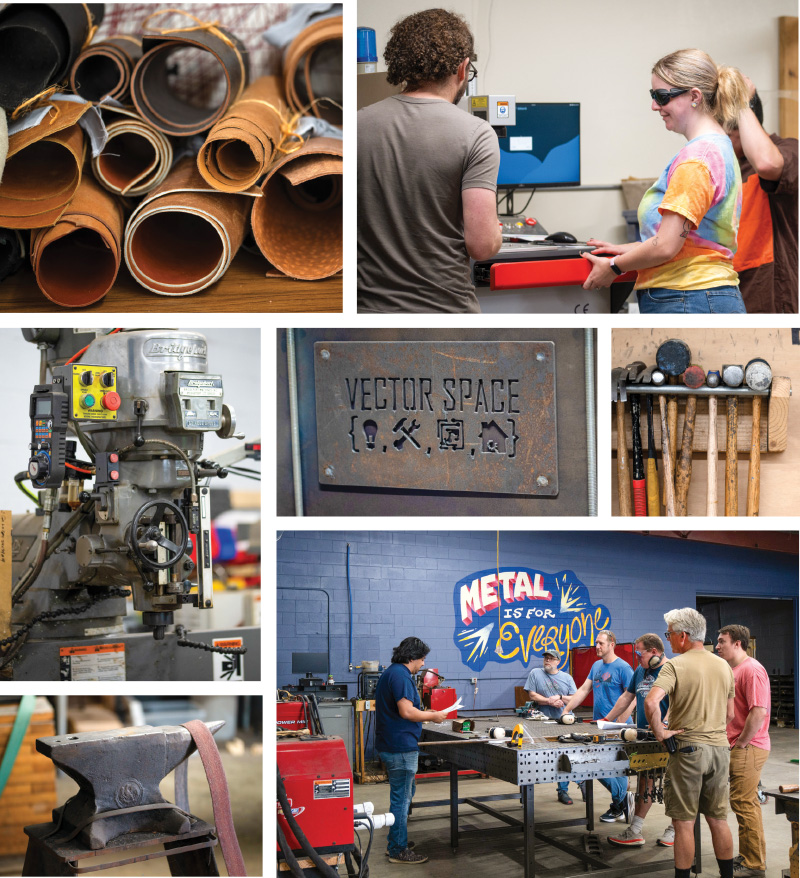
Accepting that one is always learning, always a work in progress, allows one to adopt a maker’s mindset: a willingness and an ability to consistently face the unknown with curiosity rather than a sense of defeat. This mindset can improve all aspects of one’s career and life, and it is especially important for those who choose to pursue entrepreneurship.
“As an entrepreneur, when you’re starting your business, you wear all the hats,” explained Elise. “The more of those hats that you have that you can put on—if you can be your own plumber, your own web designer, all of those things—the better. Makers are good entrepreneurs because they already have so many hats that they can put on. As an entrepreneur, you can’t hire out all the things because you’ll run out of cash flow! And not only do you have to be able to do a lot of things that you know you’re going to have to do, you also have to be ready to try to do things you didn’t know were coming. That growth mindset, that maker mindset of ‘OK, here’s a problem; I don’t know how to solve it, but I’ve solved enough problems now that I think I can figure this one out’ is really integral for successful entrepreneurship.”
In a more practical sense, a Vector Space membership also gives entrepreneurs the space and tools needed to make materials for their businesses.
Whether you are considering a Vector Space membership for a career-related reason or not, the particular vector that led you to this invaluable community space will undoubtedly continue on an upward trajectory. You will also likely find yourself transformed, on a holistic level, for the better. For those on the fence about joining, the Spontarellis encourage participation in one of their classes open to non-members and their free First Friday programs.
“Making is so fulfilling to all people and can contribute significantly to your mental wellbeing,” Adam said. “It can make you a better person!”
As Vector Space itself continues to evolve in exciting ways—including developing their highly competitive FRC team and exploring the potential for building a robotics facility that would serve as a regional robotics hub—the Spontarellis continue to be grateful for both the tangible and intangible rewards of that brave risk they took a decade ago.
“It’s great to look around at this physical place, but to hear people reflecting on their experiences here is also so rewarding,” Elise said. “A lot of members and students came up to us after our 10-year anniversary event and talked about being so proud of this makerspace as a member or volunteer. To know that we built something that other people are proud to be a part of? That’s amazing!”
For more information about Vector Space, visit vector-space.org.